
Why does a £20 bag of speciality beans often taste like disappointment when you brew it at home? With the UK coffee market now valued at £15 billion and 98 million cups consumed every day, it's clear we love the drink, yet many of us feel intimidated by the "elite" culture surrounding it. You might feel like you're wasting money on expensive equipment or getting lost in the debate between SCA and non-certified courses. This confusion stops many people from pursuing coffee education uk, leaving them stuck with inconsistent results and bitter brews.
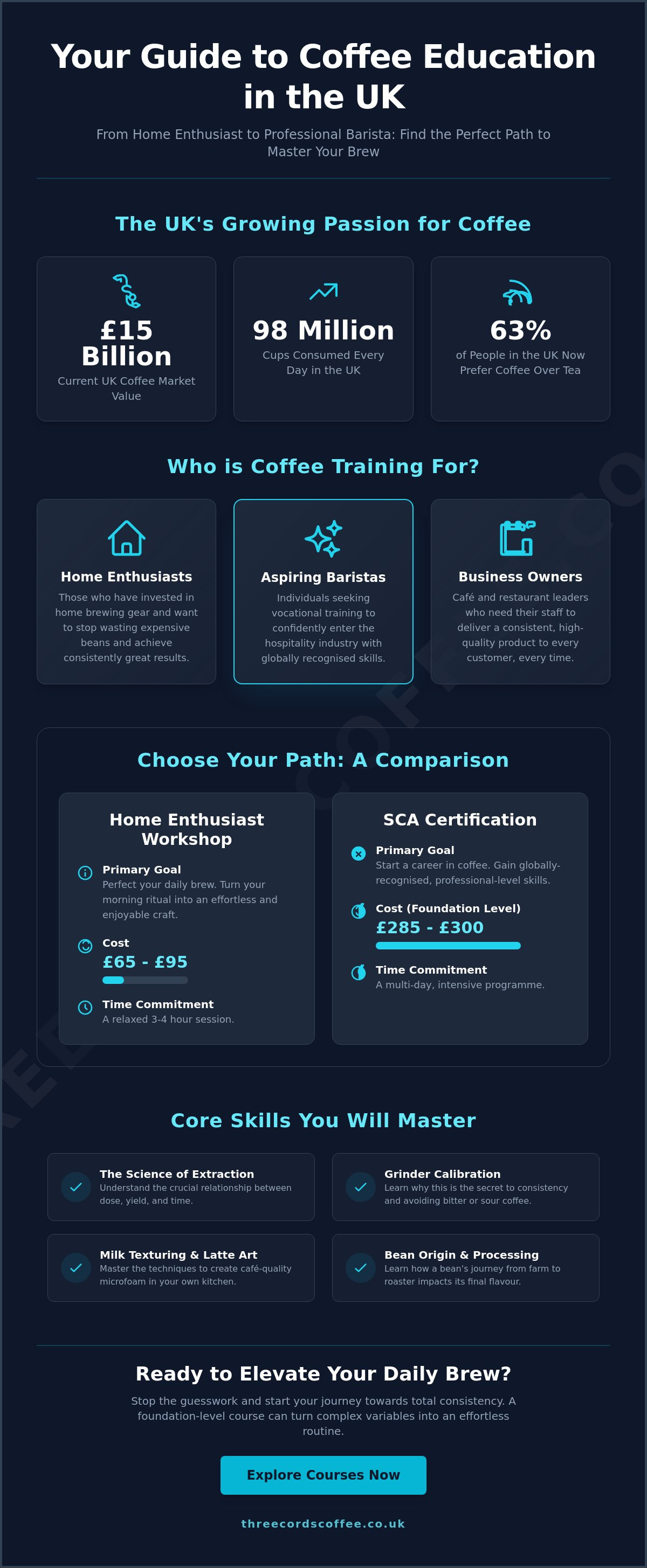
We believe that speciality coffee should be an accessible staple of your daily life, not a stressful luxury. With 63% of people in the UK now choosing coffee over tea, the demand for better home brewing has never been higher. In this guide, you'll discover the best pathways to master your craft, whether you want a £65 fundamentals course or a professional barista certification. We'll explain the "why" behind every brewing variable and provide a clear roadmap to help you achieve total consistency in every cup.
Key Takeaways
- Find your ideal coffee education uk path by comparing professional SCA certifications with accessible home enthusiast workshops that fit your schedule.
- Stop wasting expensive beans by mastering the science of extraction, including the relationship between dose, yield, and brew time.
- Learn why grinder calibration is the secret to consistency and how to adjust your settings to avoid bitter or sour results.
- Identify high-quality training providers by looking for Authorized SCA Trainers and commercial-grade equipment that mimics a professional environment.
- Discover how a foundation-level course can turn complex technical variables into an effortless and enjoyable daily brewing routine.
Understanding the Landscape of Coffee Education in the UK
The UK high street has changed. A decade ago, "speciality" was a niche term reserved for a handful of London roasteries. Today, with over 12,313 branded coffee shop outlets across the country, the demand for high-quality, origin-focused coffee has moved into the mainstream. This shift has transformed coffee education uk from a gatekept industry secret into a vibrant, accessible spectrum of learning. Whether you're curious about why your home espresso tastes sour or you're looking to start a career behind the bar, there's a pathway designed for you.
In its simplest form, coffee education is the systematic study of bean origin, roast profile, and extraction science. It bridges the gap between buying a bag of beans and actually enjoying the complex flavours promised on the label. It moves the process away from guesswork and towards a repeatable, enjoyable craft.
The Growth of Speciality Coffee Knowledge
British coffee culture has moved far beyond the era of instant granules. We now see consumers asking about altitudes, processing methods, and harvest dates. This evolution is driven by a desire for consistency. At Three Cords, we focus on three essential elements: the bean, the roast, and the brew. If one of these is out of sync, the final cup suffers. Understanding this "Three Cords" philosophy is the first step toward better coffee.
Learning from a roaster provides a unique advantage because they handle the product from the green bean stage through to the final roast. This deep connection to the source is often missing in generic workshops. While many organisations, such as the Specialty Coffee Association (SCA), provide the global framework for these industry standards, the real magic happens when you apply those professional principles to your everyday routine. It's about making the "expert" level approachable for everyone.
Who is Coffee Training For?
There's a common misconception that coffee training is only for people who want to wear an apron professionally. We reject that snobbery. Coffee education uk is for anyone who values their morning ritual. We generally see three groups of people in our training sessions:
- Home Enthusiasts: People who've invested in an Aeropress or a home espresso machine and want to stop wasting expensive beans.
- Aspiring Baristas: Individuals looking for vocational training to enter the hospitality industry with confidence.
- Business Owners: Café or restaurant leaders who need their staff to deliver a consistent, high-quality product every time.
Professional skills aren't just for the workplace. Techniques like milk texturing, which you'll learn in a Barista Skills Foundation Course, are exactly what you need to create café-quality latte art in your own kitchen. Education is about removing the mystery and making the process effortless, regardless of your ultimate goal. It's about giving you the confidence to brew better, every single day.
Choosing Between SCA Certification and Home Enthusiast Workshops
Deciding how to invest in your skills can feel like a minefield. On one side, you have high-level professional qualifications; on the other, relaxed afternoon sessions at a local roastery. According to the British Coffee Association, coffee consumption is at an all-time high, and this growth has created a diverse market for coffee education uk. The right choice depends entirely on whether you want a career in the industry or simply a better tasting cup on a Tuesday morning.
Time and cost are the biggest differentiators. A professional certification typically requires a multi-day commitment and a significant financial investment. For instance, an SCA Barista Skills Foundation course often costs between £285 and £300. In contrast, an informal workshop usually lasts three to four hours and costs between £65 and £95. For many, a foundation-level course serves as the perfect middle ground. It provides the technical depth of a professional programme without the intense pressure of a multi-day diploma track.
What is the SCA Coffee Skills Programme?
The Specialty Coffee Association (SCA) is the global authority on coffee standards. Their Coffee Skills Programme is divided into six distinct modules: Introduction to Coffee, Barista Skills, Brewing, Sensory, Green Coffee, and Roasting. Each module has three levels: Foundation, Intermediate, and Professional. As you complete these, you earn points that eventually lead to a Coffee Skills Diploma. Because these certifications are internationally recognised, they are the gold standard for anyone planning to work in speciality cafes across the globe. It's a structured, academic approach to the craft.
The Benefits of Informal Roastery Workshops
If you aren't looking for a new career, informal workshops offer a hands-on, low-pressure environment. These sessions are often tailored to specific equipment that people actually use at home. You might find a workshop dedicated entirely to the Aeropress or a session focused solely on home espresso calibration. There are no exams here. Instead, the focus is on the social aspect of learning alongside fellow coffee lovers. You get to ask "silly" questions, make mistakes, and leave with practical tips you can use immediately. It's about making your daily ritual more enjoyable without the need for a certificate on the wall.
Whether you choose the formal or informal route, the goal is the same: consistency. Understanding the variables of your brew removes the frustration of "hit and miss" results. If you're ready to move beyond basic workshops but aren't quite ready for a professional diploma, a foundation-level course offers the best of both worlds.
Core Skills: What a Barista Skills Foundation Course Actually Teaches
A common myth in the world of coffee is that the machine does all the work. In reality, even the most expensive commercial setup can produce a poor cup if the person behind the portafilter doesn't understand the variables. When you invest in coffee education uk, you aren't just learning to press buttons; you're learning to control the science of extraction. This involves balancing three critical pillars: dose (the amount of dry coffee), yield (the weight of the final liquid), and brew time. Mastering these ensures that your morning brew is repeatable and balanced every single day.
The grinder is arguably more important than the espresso machine itself. Grinder calibration, often called "dialing in," is the process of adjusting the distance between the burrs to control how fast water flows through the coffee. A setting that worked yesterday might not work today due to changes in humidity or the age of the beans. Beyond the grind, professional courses teach the often-overlooked skill of equipment maintenance. Keeping your kit clean isn't just about hygiene; it's about preventing old oils from turning rancid and ensuring the heating elements perform at their peak. A well-maintained machine is the only way to get the best out of a high-quality House Espresso Blend.
Mastering the Espresso Shot
Dialing in is a sensory journey. You start with a recipe, but you finish with your palate. If a shot tastes sharp and vinegary, it's under-extracted, meaning the water didn't pull enough flavour from the grounds. If it's unpleasantly bitter and dry, it's over-extracted. A key barrier to a perfect shot is channelling. Channelling is defined as the process where water finds the path of least resistance through the coffee puck, resulting in a weak, under-extracted, and inconsistent brew. You avoid this by perfecting your distribution and tamping technique, ensuring the coffee bed is perfectly level and compact before the water hits it.
The Art and Science of Milk Texturing
Achieving that velvet-smooth "micro-foam" for a flat white requires more than just heat. It's a two-stage process: aerating and stretching. Aerating happens in the first few seconds as you introduce air into the milk to create volume. Once you have enough foam, you submerge the steam wand slightly to create a vortex, which "stretches" the milk and breaks down large bubbles into tiny, microscopic ones.
Temperature control is where many people go wrong. The "sweet spot" for milk is between 60-65°C. At this temperature, the lactose in the milk is at its most soluble and tastes naturally sweet. If you go beyond 70°C, the proteins break down, the sweetness vanishes, and you're left with a burnt taste that masks the delicate notes of your coffee. Latte art is the final step, but it's more than just a decoration; it's a visual indicator that your milk texture and espresso crema are both of high quality.
How to Evaluate a Coffee Training Provider in the UK
Choosing where to invest in your coffee education uk shouldn't feel like an audition for an exclusive club. While some providers rely on a central London postcode to signal quality, the real value lies in the expertise of the trainer and the quality of the environment. Look for a school led by Authorized SCA Trainers (ASTs) or head roasters who have spent thousands of hours at the machine. These mentors understand that teaching is about making complex science feel effortless, not about gatekeeping knowledge.
The physical setup of the training centre is just as important as the person teaching. You should always train on commercial-grade equipment. Professional machines and grinders allow you to understand the limits of physics, such as thermal stability and pressure consistency, which simply cannot be replicated on domestic kit. Additionally, check the class sizes before booking. A 1:4 trainer-to-student ratio is the maximum for effective hands-on learning. If a class is larger than this, you'll spend more time watching others brew than actually refining your own technique. Finally, ask about post-course support. A reputable provider will offer resources or bean discounts to help you practise what you've learned once you get home.
The Importance of Training on Freshly Roasted Beans
Training with stale supermarket beans is a waste of time and money. Old coffee loses its soluble compounds, meaning the visual and sensory cues you learn to look for, like a thick crema or a specific aroma, simply won't be there. A good school will use speciality beans roasted within the last 14 days. It's also beneficial to see how different origins behave. A bright, acidic Colombia Filter coffee requires a different approach to extraction than a chocolatey, nutty Brazil Filter. If the school roasts their own coffee on-site, it's a strong sign they understand the product from the green bean to the final pour.
Facilities and Learning Environment
A professional training centre should feel like a "friendly mentor's" kitchen, not a cold laboratory. While you want a dedicated space for "cupping" (professional coffee tasting), the atmosphere should remain pressure-free. We believe that an anti-snobbery stance is essential for learning. You shouldn't feel intimidated for not knowing a specific technical term. Accessibility matters too. High-quality training should be available across the country, ensuring that anyone can master their brew without a long commute to the capital.
If you're looking for a grounded, expert-led experience that prioritises your progress over prestige, our Barista Skills Foundation Course is designed to give you total confidence at the machine.
Elevating Your Daily Brew with Three Cords Coffee
Speciality coffee should be a daily joy, not a source of stress. Our approach to coffee education uk is built on the idea that high standards and a down-to-earth attitude can live in the same room. We've seen too many enthusiasts feel pushed away by elite coffee culture, so we've positioned ourselves as the "friendly mentor" you can rely on. Our goal is to take the mystery out of the process, replacing intimidation with the comfort of knowing exactly how to handle your equipment. When you understand the "why" behind your brew, mistakes stop being frustrating and start being lessons.
Learning is significantly more effective when you work with ingredients at their peak. Because we roast our beans weekly, you'll always be training with coffee that is fresh and vibrant. This freshness makes it much easier to distinguish between a balanced extraction and one that needs adjustment. Whether you are brewing a nutty Brazil Filter or a bright Colombia Filter, having fresh beans allows you to see the immediate impact of every small change you make to your grind or temperature. It turns a complex science into an approachable, everyday habit.
The Three Cords Barista Skills Foundation Course
Our Barista Skills Foundation Course is designed for those who want professional-level results without the unnecessary jargon. We've created a curriculum that balances essential theory with intensive "bar-time." You won't just be watching a demonstration; you'll be hands-on with the machines, refining your tamping, and perfecting your milk texturing. We focus on the practical skills that make a difference in your kitchen or cafe, ensuring you leave with a clear roadmap for your skill progression. It's about making "Specialty Coffee Made for Everyday Brewing" a reality for every student.
Continuing Your Journey at Home
True mastery comes from repetition and variety. Once you've grasped the basics, the best way to grow is to experiment with different flavour profiles. A coffee subscription is a great way to keep your skills sharp, as it introduces you to a rotating selection of single origins and blends. You might find yourself mastering the delicate balance of a Costa Rica Coffee one week and the bold body of our House Espresso Blend the next. This constant variety forces you to apply your knowledge of dose, yield, and brew time in real-world scenarios.
For those who enjoy brewing on the move, tools like the Aeropress and Aeropress Go offer a low-friction way to keep learning. They are incredibly versatile and allow you to test how different water temperatures or steep times affect the final cup. If you're ready to stop guessing and start brewing with total confidence, explore our coffee subscriptions today and start your journey toward a more consistent, effortless daily brew.
Ready to Master Your Morning Brew?
Mastering coffee shouldn't be a daunting task reserved for the elite. By understanding the landscape of coffee education uk, you've already taken the first step toward better consistency and flavour. You now know how to distinguish between £300 professional certifications and £65 roastery workshops. More importantly, you understand the "why" behind extraction variables like dose and yield. This knowledge is what turns a "hit and miss" morning into a repeatable craft you can rely on every single day.
We combine small batch roastery expertise with Authorized SCA Training principles to ensure you get professional results without the ego. Our training centre provides an anti-snobbery learning environment where every question is welcome. Whether you're looking to start a career or just want to stop wasting expensive beans, we're here to support your journey. It's time to turn your daily routine into a high-quality staple of your life. We can't wait to see your progress at the machine.
Master your skills with our Barista Skills Foundation Course and start brewing with total confidence today.
Frequently Asked Questions
Do I need prior experience to take a barista course in the UK?
No, you don't need any prior experience to enrol in a foundation level barista course. These sessions are specifically designed for people who are starting from zero, whether you are a home enthusiast or an aspiring professional. Most trainers will guide you through the basics of machine operation and milk texturing in a pressure-free environment. It is the perfect entry point into coffee education uk without the need for an industry background.
Is an SCA foundation course worth it for a home brewer?
An SCA foundation course is highly valuable for home brewers who want to eliminate guesswork from their morning routine. While the certification is technically for professionals, the technical knowledge regarding extraction and grinder calibration applies directly to home setups. It helps you understand why your brew might taste sour or bitter, allowing you to achieve café quality results in your own kitchen. It is an investment in consistency rather than just a certificate.
What is the average cost of a barista training course?
The cost of a barista training course in the UK varies significantly based on the level of certification. Informal fundamentals workshops typically cost between £65 and £95. However, a formal SCA Barista Skills Foundation course usually ranges from £285 to £300. These prices often include all beans, milk, and certification fees. Choosing the right one depends on whether you need an accredited qualification for your CV or just practical skills for your daily brew.
Can I get a job as a barista with just a foundation certificate?
You can certainly secure an entry level position with a foundation certificate, as it demonstrates a serious commitment to the craft. Many of the 12,313 branded coffee outlets in the UK value candidates who already understand the basics of food safety and espresso extraction. While you will still need on-site training to learn a specific café's workflow, having a foundation certificate gives you a significant advantage over untrained applicants during the hiring process.
How long does it take to learn basic barista skills?
You can learn the core mechanics of espresso and milk texturing in a single day. Most foundation courses last between three and seven hours, providing enough time to understand the theory and get several hours of hands-on practice. However, mastering these skills to a professional standard usually takes weeks of daily repetition. The course gives you the correct blueprint, but your consistency will improve as you brew more cups at home or behind a bar.
What equipment should I have at home before taking a course?
You don't need to own any specific equipment before attending a course, as most training centres provide commercial grade kit for you to use. In fact, it is often better to take the course first so you can learn what features to look for in a home machine or grinder. If you already have an Aeropress or a basic espresso machine, you can use the skills you learn to calibrate your existing setup more effectively once you return home.
Are online coffee courses as effective as in-person training?
Online courses are useful for theory, but they cannot replace the tactile and sensory feedback of in-person training. Coffee is a physical craft that requires you to smell, taste, and feel the texture of the milk. Without a trainer there to taste your shots or correct your tamping posture, it is easy to develop bad habits. In-person coffee education uk ensures you are calibrated to professional industry standards from the very first pour.
What is the difference between a brewing course and a barista course?
The primary difference lies in the equipment used and the method of extraction. A barista course focuses almost exclusively on espresso machines, milk texturing, and high pressure brewing. A brewing course, however, covers manual and filter methods like the Aeropress, V60, or Chemex. While both involve the science of extraction, a brewing course is often more relevant for those who prefer black coffee and want to master manual home filter techniques.